Your cash-secured put went red. Now what?
You sold a put because you'd be happy to own the stock at that price. Now the stock is below your strike, the position is red, and your thumb is hovering over the close button.
Deep breath. Nothing has gone wrong yet.
The number to look at first
Forget delta for a second. Look at what you actually put on the table:
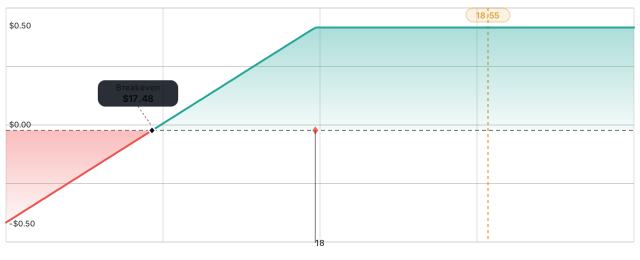
Total cost: $1,748.
That's the cash you had to have sitting there — $18 strike × 100 shares = $1,800 — minus the $52 you collected for selling the put. One number, and it answers three questions:
- What did this trade require? $1,748 in the account, or it wasn't a real trade.
- What's my price if I get assigned? $17.48 a share.
- What's the most I can lose? $1,748 — and only if SOFI goes to zero. That's the whole reason you picked a stock you'd want to own.
If $1,748 feels like a lot of money, the trade was too big. And that's a sizing decision you make before the entry, not one you make with a red screen in front of you.
Then it fell. Fast.
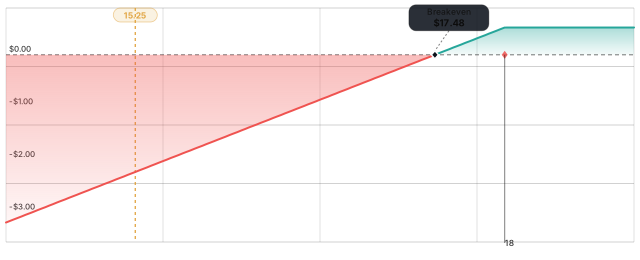
SOFI closed at $18.55 when the put was sold. Eleven trading days later it closed at $15.25 — down 17.8% — and the put you'd sold for $0.52 was worth $2.73. That's −$221, about 12% of the cash you'd set aside. This is the part nobody posts screenshots of.
Two things you'll want to do
Roll it. A roll feels like dodging the loss. It isn't an exit — it's a bigger bet: new expiry, usually a worse strike, often twice the capital committed. Perfectly fine if that was the plan. Less fine if it's a flinch.
Close it at the ugliest price. Buying the put back at $2.73 turns a bad screen into a real −$221. If your rule said "close at $2.73", you'd have closed at $2.73 back then. If it didn't, you're not following a rule — you're following your stomach, which is expensive and has terrible timing.
How this one ended
SOFI recovered. It finished at $18.38, the put expired worthless, and the $52 stayed. Lovely.
Now the part that actually matters: the recovery proves nothing. It rescued a decision that was never tested. Had SOFI just sat near $15, you'd own 100 shares at $17.48 and this post would end completely differently — same trade, same plan, and you don't get to choose which ending you get.
The only question
The entire decision fits in one line: would I still be happy to own this stock at the strike?
Yes? Then you're not waiting to be rescued, you're waiting to buy — and the plan is the shares, plus selling calls against them. That's the wheel: the put was just your way in.
No? Then it was never really cash-secured. You don't have the cash, or you don't want the stock at that price. Close it while the choice is still yours, not the market's.
Three things have to be true for "let it go" to be a plan rather than a shrug: the cash is genuinely reserved, the strike is one you'd own at, and you know what happens next. Miss one, and "let it go" is just a politer way of saying you hadn't decided.
Educational content, not advice. Prices are real (Nasdaq daily closes); option values are computed from those closes at 42% IV — model values, not historical quotes, and not our fills. Next in this series: the covered call, where letting it go means missing the rally.